
Source code is structured and easy to validate. How can you validate meeting notes and test commercial analysis?
During my recent workshop, I found that Project Managers were more interested in AI agents than the Developers in the room.
The reason became obvious: with a little help, PMs can improve their effectiveness in several distinct areas.
The problem
Software development is relatively easy to automate, but project management is more versatile and requires a different approach.
Project Managers work with mostly unstructured and fragmented data:
- meeting notes
- mockups
- status updates
- strategy guidelines
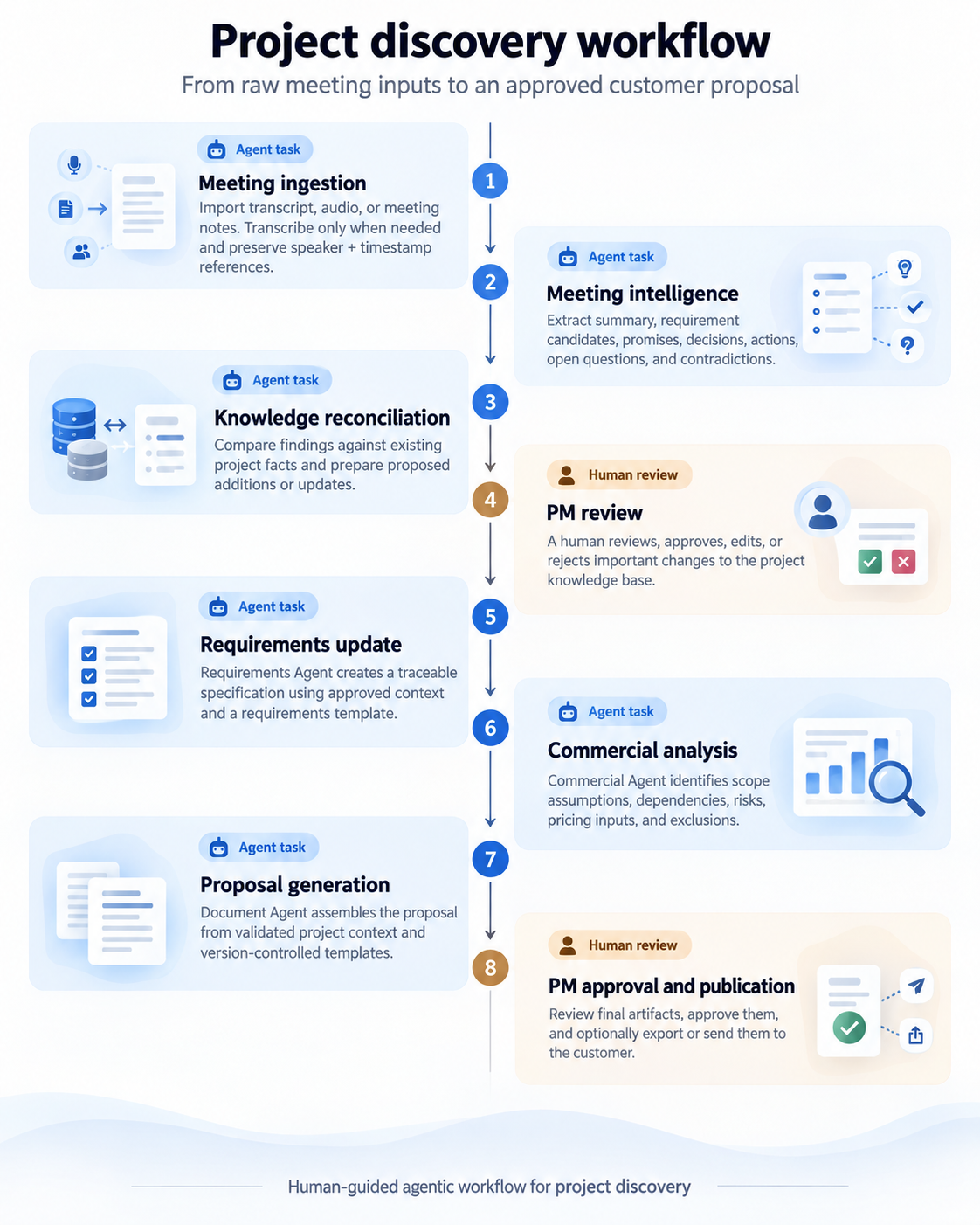
To address this challenge, I started to work on the following Project Discovery Workflow.
The workflow
Legend: 🤖 agent-driven · 👤 human-driven
| # | Step | Owner | Output |
|---|---|---|---|
| 1 | Meeting ingestion | 🤖 | Transcript with speaker and timestamp references |
| 2 | Meeting intelligence | 🤖 | Summary, requirements candidates, decisions, actions, open questions, contradictions |
| 3 | Knowledge reconciliation | 🤖 | Proposed additions and updates |
| 4 | PM review | 👤 | Approved project knowledge base |
| 5 | Requirements update | 🤖 | Traceable specification |
| 6 | Commercial analysis | 🤖 | Scope assumptions, dependencies, risks, pricing inputs |
| 7 | Proposal generation | 🤖 | Proposal assembled from validated context |
| 8 | PM approval and publication | 👤 | Approved artifacts sent to the customer |
Notes:
-
Meeting ingestion 🤖
Import transcript, audio, or meeting notes. Run transcription/diarization only when needed; preserve speaker and timestamp references.
-
Meeting intelligence 🤖
Extract summary, requirements candidates, promises, decisions, actions, unresolved questions, and contradictions.
-
Knowledge reconciliation 🤖
Compare extracted findings against existing project facts and prepare a set of proposed additions or updates.
-
PM review 👤
Human approves, edits, or rejects important changes to the project knowledge base.
-
Requirements update 🤖
Requirements Agent produces a traceable specification using approved context and the requirements template.
-
Commercial analysis 🤖
Commercial Agent identifies scope assumptions, dependencies, risks, pricing inputs, and potential exclusions.
-
Proposal generation 🤖
Document Agent assembles the proposal from validated project context and version-controlled templates.
-
PM approval and publication 👤
Review final artifacts, approve them, and optionally export or send them to the customer.
Two steps out of eight
Two of eight steps are human. That’s deliberate - agents 🤖 draft, people 👤 decide.
CTA
👉 PMs - which of these steps would you trust an agent with today, and which would you never hand over? Genuinely curious where the line is.